
Mixed Marriages (Mischehen) in the Austrian part of the Austro-Hungarian Empire (1867–1918)
By Dor Correct
As part of my research on the Austrian-Jewish jurist Emil von Hofmannsthal (1884-1971), I delved into the question of intermarriage (Mischehen) between Christians and Jews in Austria. Hofmannsthal emerged as one of the most consistent and articulate advocates of such unions in the final decades of the Habsburg Monarchy and throughout the First Austrian Republic. He addressed the subject in a series of publications, spoke in Parliament and in court, and advocated for amending Austrian family law to recognize such marriages. His commitment to the issue was not merely theoretical: in 1923, he himself married a Catholic Hungarian woman. For Hofmannsthal, failing to recognize mixed marriages not only reinforced the social marginalization of Jews but also violated Austria’s constitutional and international obligations to equality — principles, according to him, first articulated in the 1867 Constitution and reaffirmed in the Treaty of Saint-Germain (1920). For him, love was a "fundamental human right" beyond the legitimate authority of the state to restrict or deny.
For centuries, subjects of the Habsburg Empire — as in other states — were prohibited from marrying outside their religions (Interconfessional marriages, such as those between Protestants and Catholics, were permitted in the Monarchy starting in 1783). The nineteenth century, however, brought sweeping legal transformations across Europe, particularly in marriage law. Civil marriage was introduced in Italy (1865), Germany (1876), and even the Hungarian half of the monarchy (1895), thereby enabling interfaith couples to enter into legally valid unions. Austria, by contrast, remained the only Central European state where matrimonial law remained under religious jurisdiction (this was the case until July 1938, following the Anschluss). Yet, individuals found creative strategies to circumvent this barrier — temporary conversions, exceptional ecclesiastical dispensations, marriages to foreign nationals (as in Hofmannsthal’s case), and more.
The phenomenon of intermarriage offers an especially fruitful vantage point for the study of state-society relations, interreligious encounters, and minority integration. Far from being a marginal curiosity, these unions illuminate the broader dynamics of social transformation. From an institutional perspective, intermarriages reveal how state authorities and local communities engaged with religious and cultural diversity. From an individual perspective, they expose the pressures and negotiations of everyday life: mixed couples often faced the combined weight of bureaucratic obstacles, family expectations, and social stigma. In this sense, intermarriage exemplifies the tension between political structures imposed "from above" and lived experiences "from below". The regulatory regimes that restricted, tolerated, or facilitated such unions reflect not only the cultural climate of the Monarchy but also the complex interactions between individuals, religious institutions, and the state.
Christian-Jewish marriages underscore the enduring tensions between tradition and modernity within both religious communities. They constituted critical moments in interfaith relations, highlighting evolving self-perceptions and religious practices. The so-called "mixed marriage question" ("die Frage der Mischehen") illustrates how Christians and Jews alike struggled to preserve their traditions while simultaneously adapting to changing social realities. These unions demonstrate that the two communities often responded to the same challenge in divergent ways — normatively, institutionally, and practically. Across the Habsburg Monarchy, with its mosaic of ethnicities and religions, such unions transcended territorial and social boundaries, and can be seen as integrative mechanisms linking regions, faiths, and populations. These connections also highlight the dual dimensions of minority integration: assimilation and diversity. Some cases reflected adaptation to majority norms, often entailing a distancing from the Jewish community, while others demonstrated the preservation of a distinct identity through continued participation in communal life or the observance of Jewish holidays. Accordingly, they provide a powerful lens for understanding cultural transformation and the minority experience in the late Habsburg world.
The ambivalent path that promised Jews freedom and participation in bourgeois society simultaneously risked social segregation if they failed to conform to bourgeois Christian norms. These dynamics persist: even in contemporary Austria, where nearly one-third of Jews marry non-Jewish partners, mixed families frequently endure a "double exclusion" — perceived as Jewish by the non-Jewish majority, yet often regarded as insufficiently Jewish by Jewish communities. Examining the history of the intermarriages not only reframes our understanding of past processes of inclusion but also underscores the dangers minorities face when integration policies privilege assimilation over diversity — when, in the context of marriage, one partner is compelled to relinquish their identity "for love's sake".

|
S. Weinstock, Die neuesten Vorschriften betreffend die Verfassung der österreichischen Rabbinats und Ehegesetze mit Erläuterungen in hebräischer Sprache (Lemberg: Ch. Rohatyen Platz, 1899). In Yiddish. |
|
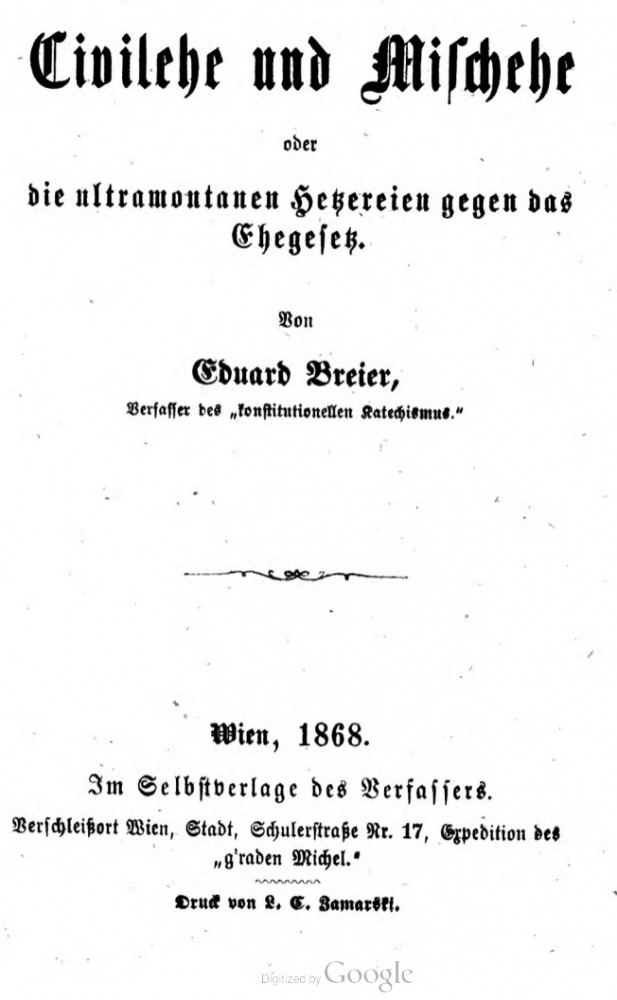
Eduard Breier, Civilehe und Mischehe oder die ultramontanen Hetzereien gegen das Ehegesetz. (Wien: Breier Verlag, 1868) |